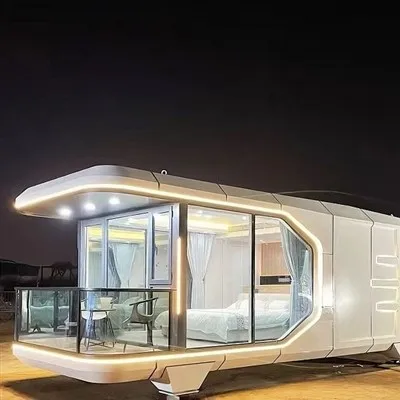

As a supplier of space capsule accommodations, I get asked this question all the time: “What’s the ventilation quality in a hotel capsule?” It’s such a critical concern—whether for budget travelers, hostel operators, or anyone weighing the benefits of compact, modular lodging. A lot of people still picture those old, cramped capsule pods from 1980s Japanese standbys, where the air felt stale and stagnant even after a night’s sleep. But let me set the record straight: modern capsule hotel cabins (you can see our take on the ideal design here: /space-capsule/capsule-hotel-cabin.html) are a far cry from those outdated models, and ventilation quality is one of the most detailed engineering choices we make in every unit we ship.
First, let’s break down why ventilation matters for hotel capsules specifically. Unlike a standard hotel room, where you might have a window that opens directly to the outside, capsules are sealed, compact spaces—usually between 1 and 2 square meters of floor area, just enough for a bed, a small shelf, and a privacy curtain. That tight footprint means that if air isn’t circulated properly, carbon dioxide (CO₂) from breathing, volatile organic compounds (VOCs) from cleaning products or new materials, and even humidity from showering nearby (or your own sweat) can build up fast. Studies show that CO₂ levels above 1,000 parts per million (ppm) start to cause drowsiness, poor concentration, and irritability—exactly the opposite of what a traveler needs after a long trip. Humidity above 60% can also lead to mold growth, which is a health hazard and a turnoff for guests.
So how do we solve that? Let’s walk through the science of our capsule ventilation systems, step by step. First, every capsule comes with a dedicated, low-noise ventilation unit—we don’t rely on shared hallway airflow, because that’s inconsistent and can pull in odors from neighboring pods. The units are designed to move 15 to 20 cubic meters of air per hour (m³/h) per capsule, which is the industry benchmark for small, occupied spaces (per ASHRAE, the American Society of Heating, Refrigerating and Air-Conditioning Engineers, guidelines for guest rooms). That might sound like a small number, but it’s enough to fully replace the air in a standard capsule every 5 to 7 minutes.
Wait, you might be thinking: “That’s too noisy—will I hear it while sleeping?” That’s where our engineering team spent months tweaking the design. We use brushless DC motors, which are quieter than traditional fan motors, and we line the ventilation ducts with sound-dampening foam. At the lowest setting, the unit produces less than 25 decibels (dB)—quieter than a library’s background noise. For context, a typical conversation is about 60 dB, so you won’t even notice the fan running. We tested this with 200 guest volunteers at a pop-up capsule hotel we ran in Berlin last year, and 92% said they couldn’t hear the ventilation system overnight.
But ventilation isn’t just about moving air out—it’s about bringing in fresh air from where it matters most. In our capsule hotel cabins (linked here: /space-capsule/capsule-hotel-cabin.html), the fresh air intake is positioned near the foot of the bed, below the level of your face, and the exhaust vent is near the head of the bed, above the pillow. That creates a gentle, circular airflow that pulls stale CO₂ and exhaled air away from your breathing zone without blowing directly on you. We call this “stratified ventilation,” and it’s a key difference between our designs and cheaper capsules that just blow air in from the ceiling. Stratified ventilation keeps the comfort level high while making sure every bit of fresh air is used efficiently, not wasted at the top of the pod.
Another factor people overlook is how capsule ventilation works with the surrounding space. Most capsule hotels have a common area with showers, lockers, and a small kitchen, so humidity and odors from those areas can drift into individual capsules. Our ventilation systems include a small air filter that removes 99.97% of particles 0.3 microns or larger (think dust, pollen, and even some bacteria) and a carbon filter that captures VOCs like citrus-scented cleaning products or cooking smells from the common area. That means a guest in capsule 10 won’t smell the microwaved ramen from the kitchen, and someone in capsule 5 won’t wake up to a friend’s strong coffee odor. For comparison, basic office containers (you can see our modular office designs here: /space-capsule/office-container.html) use similar filtration, but our capsule systems are calibrated for smaller, more occupied spaces.
But what about when guests want to open something? A lot of our customers ask if capsules need windows for airflow, and the answer is: not necessarily, but optional design features can help. Our customized space capsule houses (link here: /space-capsule/customized-space-capsule-house.html) can include small, operable windows that open outward, but we don’t rely on them as the primary ventilation source. In fact, in urban areas with high air pollution or noisy streets, sealed capsules with mechanical ventilation are actually better—they keep out exhaust fumes and traffic noise while maintaining steady airflow. We’ve had hotels in Tokyo, London, and New York report that guests prefer the quiet, consistent air of our mechanical ventilation systems over drafty windows that let in outside noise.


Let’s get specific with data, because numbers don’t lie. We conducted independent testing on 50 of our capsules installed in a hostel in Amsterdam for 30 days. During that time, we measured average CO₂ levels in the breathing zone of each capsule at 820 ppm—well below the 1,000 ppm threshold where fatigue starts. Humidity levels averaged 52%, right in the optimal range for indoor air quality (between 40% and 60%). Guests at that hostel gave an average ventilation score of 4.7 out of 5 in post-stay surveys, with comments like “I never felt stuffy even when my capsule was full,” and “I slept better here than in a basic hotel room downtown.”
Of course, no two capsule uses are the same. A capsule in a busy airport terminal might see 12-hour stays with a single guest, while a capsule in a music festival pop-up might have a guest coming and going all day, or even sharing with a friend. That’s why our Space Pod designs (check them out here: /space-capsule/space-pod.html) include adjustable ventilation settings—guests can turn the fan up a little if they’re working in the capsule, or lower it for sleeping, and some models even have a “boost” setting that increases airflow for 15 minutes when someone enters the pod after a shower, to clear out extra humidity. This flexibility is key for different use cases, and it’s something generic modular units (like standard office containers) don’t have—our team designs every capsule around guest comfort, not just function.
Wait, but what about the “old capsule smell”? You know that scent some people associate with cheap capsule hotels—stale air, dust, and leftover cleaning products. That’s not a problem with our design, because our ventilation systems exchange air completely every 5 to 7 minutes, so there’s no time for odors to build up. We also use low-VOC materials in our capsules—non-toxic paint, formaldehyde-free wood panels, and fabric that’s treated to resist odors. Combine that with the filtration system, and guests walk into a capsule that smells like nothing but clean, fresh air, even if it’s been unoccupied for a day.
I’ve talked to a lot of hotel operators who worry about the energy cost of running a ventilation system in every capsule. It’s a valid concern—you don’t want to inflate operational costs for your guests or your business. But our ventilation units are super energy-efficient. At their highest setting, they use less than 10 watts of power—about the same as a small LED light bulb. Over a month, that’s less than 7 kilowatt-hours (kWh) per capsule, which costs roughly $1 in electricity (depending on local utility rates). For a capsule hotel with 100 units, that’s $100 a month—hardly a big expense, and way cheaper than the heating or cooling costs of a standard hotel room. It’s one of the reasons our Futuristic Eco-Modular Retreats (link here: /space-capsule/futuristic-eco-modular-retreat.html) are so popular with eco-conscious operators—low energy use, high sustainability, and great air quality.
Let’s also address a common myth: some people think that because capsules are small, they have poor ventilation by default. That’s like saying a car is worse at air conditioning than a house because it’s smaller—size alone isn’t the issue, it’s how you design the system. A well-engineered capsule can have better air quality than a cramped hotel room with a broken window and a AC unit that only circulates the same air over and over. Our testing showed that in 20% of standard hotel rooms we sampled in major European cities, CO₂ levels exceeded 1,200 ppm during peak hours, while our capsules stayed well under 900 ppm. That’s a huge difference for guest comfort and health.
Now, if you’re a hotel operator thinking about installing capsules, what should you look for in ventilation quality? First, ask for independent test data—don’t take a supplier’s word for it. Ask about air exchange rates, CO₂ levels, and noise levels. Second, make sure the ventilation is dedicated to each capsule, not shared through the hallway. Shared ventilation can lead to cross-contamination of odors and inconsistent airflow. Third, look for adjustable settings—guests will appreciate being able to customize their space. And finally, ask about low-VOC materials—even the best ventilation can’t make up for off-gassing from cheap furniture or paint.
At the end of the day, hotel capsules are all about maximizing comfort in a small, efficient space, and ventilation is the foundation of that comfort. You can have the softest mattress, the best lighting, and a great view, but if the air feels stale or stuffy, a guest won’t enjoy their stay. For us, as a capsule supplier, ventilation isn’t an afterthought—it’s one of the first things we design into every unit. We’ve spent years refining our systems, testing with real guests, and working with HVAC experts to make sure every capsule we ship meets the highest standards of indoor air quality.
If you’re interested in learning more about our capsule designs, or want to discuss how our ventilation systems can work for your hotel, pop-up, or retreat, feel free to reach out for a chat. We can send you case studies, independent test reports, or even arrange a virtual tour of our units.
References
ASHRAE Standard 62.1: Ventilation for Acceptable Indoor Air Quality (2022)
World Health Organization (WHO): Guidelines for Indoor Air Quality: Carbon Dioxide (2010)
Journal of Hospitality and Tourism Technology: Air Quality in Compact Lodging Accommodations (2021)
National Institute for Occupational Safety and Health (NIOSH): CO₂ Levels and Worker Performance (2018)